Wrapped vs Raw-Edge Cogged V-Belts: Which Fits the Drive?
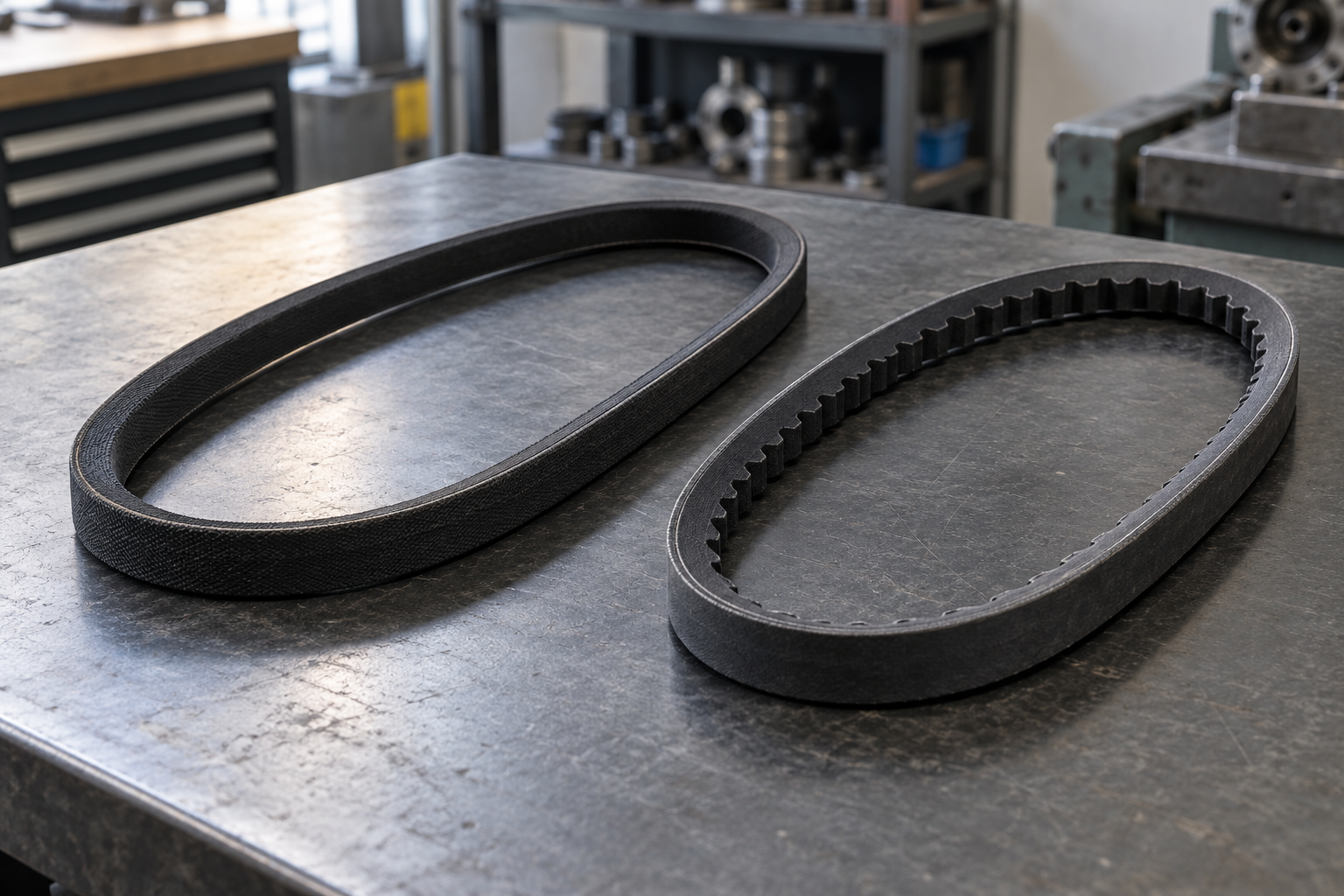
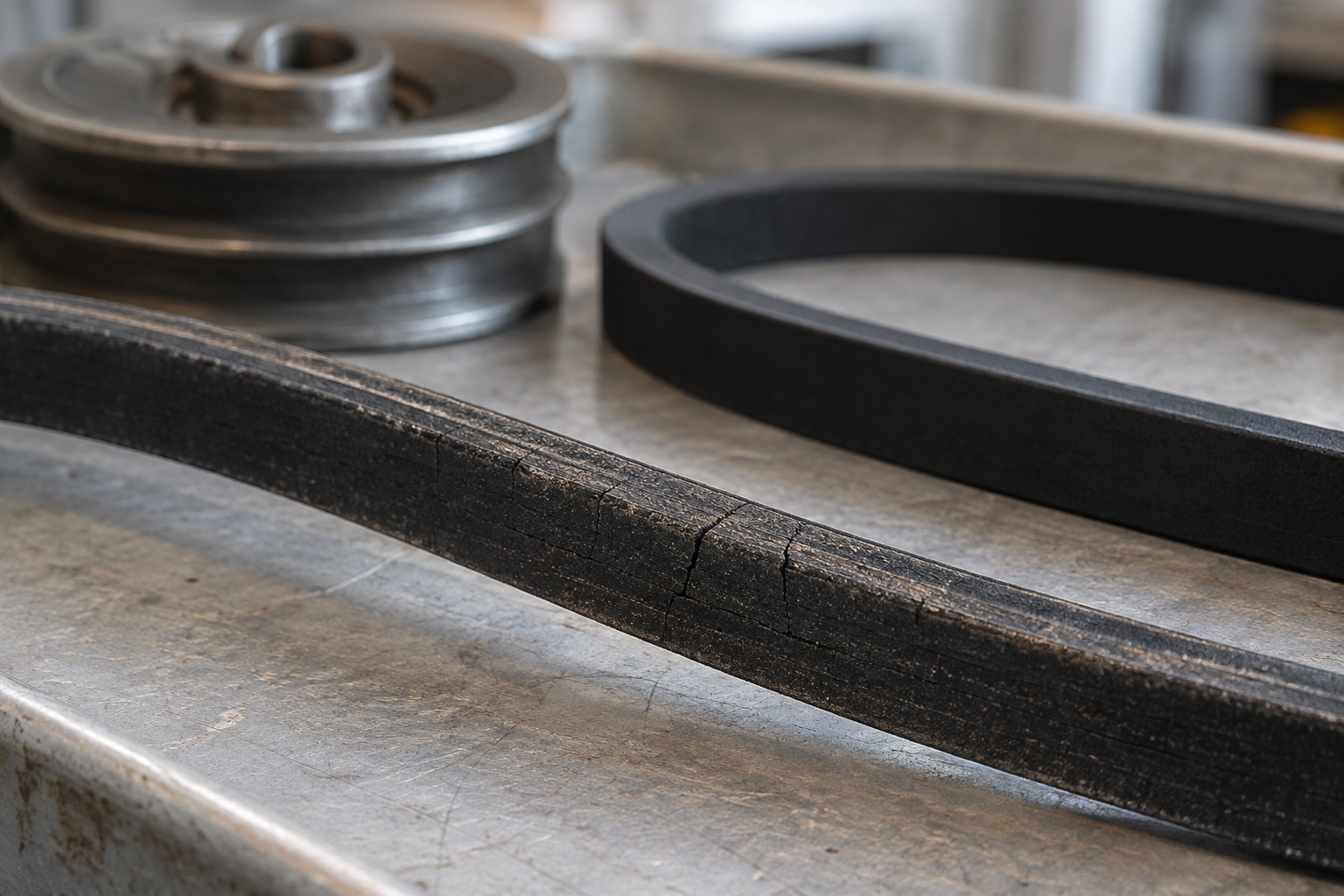
Wrapped and raw-edge cogged belts are both friction-drive V-belts. The fabric cover, sidewall construction and bending behaviour differ. Select against the complete drive requirement—not the assumption that one construction is always an upgrade.
A cogged V-belt can look like a timing belt when viewed from the underside. That visual similarity is misleading: its notches allow the belt body to flex; they do not turn a V-groove drive into a synchronous drive. The groove profile and the belt’s sidewall contact still matter.
What changes in the construction?
A wrapped belt carries a fabric cover around its body. In a raw-edge cogged construction, the sidewalls are exposed and finished, and the underside has moulded notches. The notched underside reduces bending resistance as the belt passes around a pulley. The useful engineering question is whether those features suit the drive’s pulley sizes and duty.
A construction label is not a complete performance rating. The compound, tensile cord, section, permitted speed, temperature range and manufacturer’s design data determine the actual product’s capabilities. A published advantage for one proprietary range should not become a blanket claim for every cogged belt.
Compare the drive, not just the belt
| Selection point | Wrapped V-belt | Raw-edge cogged V-belt |
|---|---|---|
| Sidewall construction | Fabric cover around the belt body. | Exposed, precision-finished sidewalls; moulded relief notches on the inside. |
| Bending around a pulley | Use the pulley limits for the exact belt section and construction. | The cogged underside improves flexibility; check the product’s permitted pulley diameter. |
| How drive force is transmitted | Friction at the pulley groove sidewalls. | Also friction at the groove sidewalls; the notches do not engage timing-pulley teeth. |
| A small or compact drive | Check whether the chosen section can work within the available geometry. | A useful option to evaluate where bending flexibility is important. |
| A drop-in replacement? | Only when the complete designation and application are approved. | Matching width and length alone does not approve a construction change. |
Comparison framework. Product-specific limits remain those of the selected manufacturer.
Where does the choice become important?
Compact layouts. When the smaller pulley or an idler dictates the design, inspect the approved minimum diameter for the exact belt. A more flexible construction may create a useful option, but it does not make an undersized pulley acceptable automatically.
Clutching or controlled slip. If the belt forms part of a clutching arrangement, friction behaviour is part of the machine function. An apparently higher-grip alternative can change that function. Retain the equipment maker’s specified construction unless the substitution has been reviewed.
Multiple-belt drives. Confirm how the manufacturer supplies compatible sets and whether the whole set is being replaced. Combining belts by nominal length alone leaves matching and load sharing unresolved.
Two offers with the same nominal dimensions
A buyer receives a wrapped belt offer and a cogged belt offer for an existing fan drive. Both suppliers repeat the nominal section and length. The machine also uses a small idler and has limited adjustment travel.
The useful comparison is not “which belt is premium?” It is whether each offered part is approved for that pulley and idler geometry, uses the correct length reference, and can be tensioned within the available adjustment. If one offer changes the construction, document that as a proposed substitution rather than silently changing the stock description.
Three common identification mistakes
- Calling every notched belt a timing belt. A V-belt notch is not a synchronous tooth-profile specification.
- Ordering by an “X” suffix alone. Suffix conventions belong to product designations; retain the complete marking and manufacturer reference.
- Using flexibility as the only selection criterion. The drive still needs the correct section, length convention, load capacity and installation procedure.
Practical conclusion
Use construction as one branch of the selection decision. For a straightforward replacement, begin with the released machine specification. For a drive redesign, compare candidate products using the same pulley geometry and duty inputs. This produces a defensible choice without treating “wrapped” or “cogged” as a universal quality ranking.
Explore the product families: Industrial V-Belts · Agricultural Belts.
For an application-specific discussion, contact CIXI ABIX with the marking or drawing and the operating conditions.