The short answerA fastener must satisfy several limits at the same time. Start with the belt’s required working tension, the thickness at the prepared splice and the relevant pulley diameter. Belt width alone cannot select the fastener.
A fastening system can appear suitable by belt thickness and still be unsuitable for the pulley or tension. The selection problem is an intersection of limits, not a choice of the nearest-looking metal plate.
Keep these three dimensions separate
| Input | Why it matters | A common comparison error |
|---|
| Required working tension | The fastener system has its own permitted rating and conditions. | Using the belt’s tensile breaking rating as though it were working tension. |
| Prepared splice thickness | The fastening size must suit the belt where it will actually be installed. | Using catalogue total thickness while ignoring specified splice preparation. |
| Relevant pulley diameter | The splice must flex around the pulleys within the fastening system’s rules. | Checking only the largest or easiest-to-measure pulley. |
| Material and environment | The fastening material must suit exposure and the application. | Assuming every fastener size is offered in every material. |
| Conveyor interfaces | Scrapers, supports and product requirements affect suitability. | Evaluating the splice in isolation from the rest of the conveyor. |
Comparison framework. Product-specific limits remain those of the selected manufacturer.
Assess working tension, prepared belt thickness and pulley diameter together. Where a cover is skived, use the prepared thickness required by the selected fastening system. The applicable fastening system’s own selection rules determine which pulleys and operating conditions must be considered.
Compare rating basis before comparing numbers
A textile belt designation such as EP 400 describes a different basis from an operating-tension requirement. Units can also conceal a mismatch: 1 N/mm equals 1 kN/m dimensionally, but identical units do not make a breaking rating and an allowable working rating the same property.
Worked example · illustrativeOne candidate passes thickness but fails tension
Suppose an engineering record specifies a maximum working tension of 35 kN/m. An illustrative fastening candidate is limited to 30 kN/m under the relevant conditions. Its thickness range happens to fit the prepared belt.
The thickness match does not cure the tension mismatch. A second candidate with a suitable tension rating remains only a candidate until its thickness, pulley and application checks also pass. These numbers illustrate the decision logic; they are not product ratings.
Hinged, solid plate or a bonded splice?
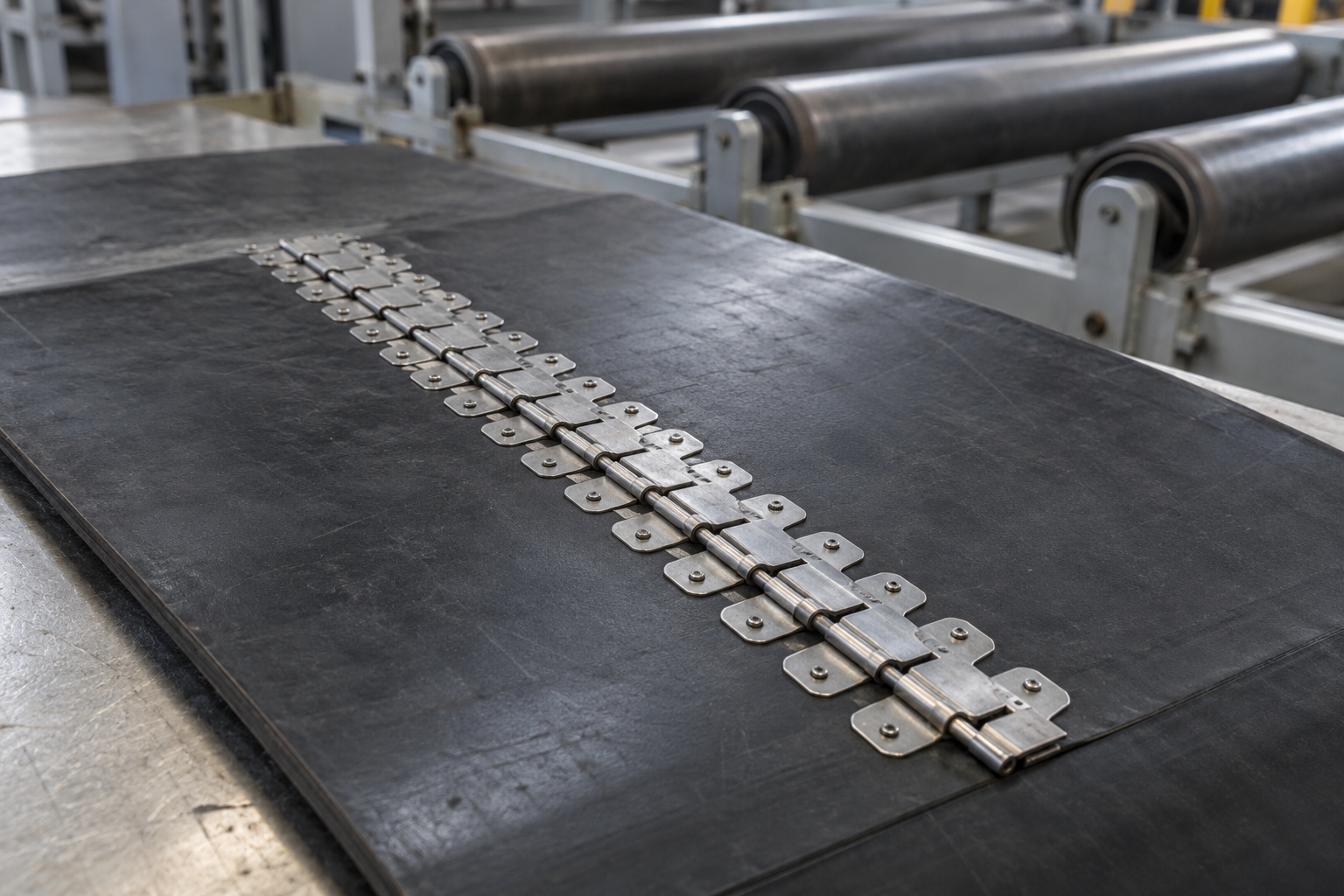
A hinged mechanical system provides an opening through its hinge arrangement. A solid-plate system is a different mechanical construction; it should not be assumed to offer the same opening method or bending behaviour. A vulcanised or otherwise bonded splice presents another construction and installation process.
Compare the reason for the splice: belt replacement access, available installation window, product containment, pulley constraints and the existing belt construction. “Mechanical” is too broad to decide every one of those questions.
The smallest pulley deserves a deliberate check
Use the exact system’s method for identifying relevant pulley diameter, including its rules for wrap and special pulley designs. Do not transfer a correction factor from another fastening family. A catalogue minimum is meaningful only with the conditions attached to it.
The same principle applies to any proposed change from an existing splice. An option that simplifies one maintenance task may require another review of conveyor interfaces.
A clear selection outcome
Retain the chosen fastening system and size, the rated conditions used, the prepared thickness and pulley basis. Keep installation to the manufacturer’s method and the site’s isolation procedures. That record explains why the fastener fits the application instead of merely recording what was purchased last time.