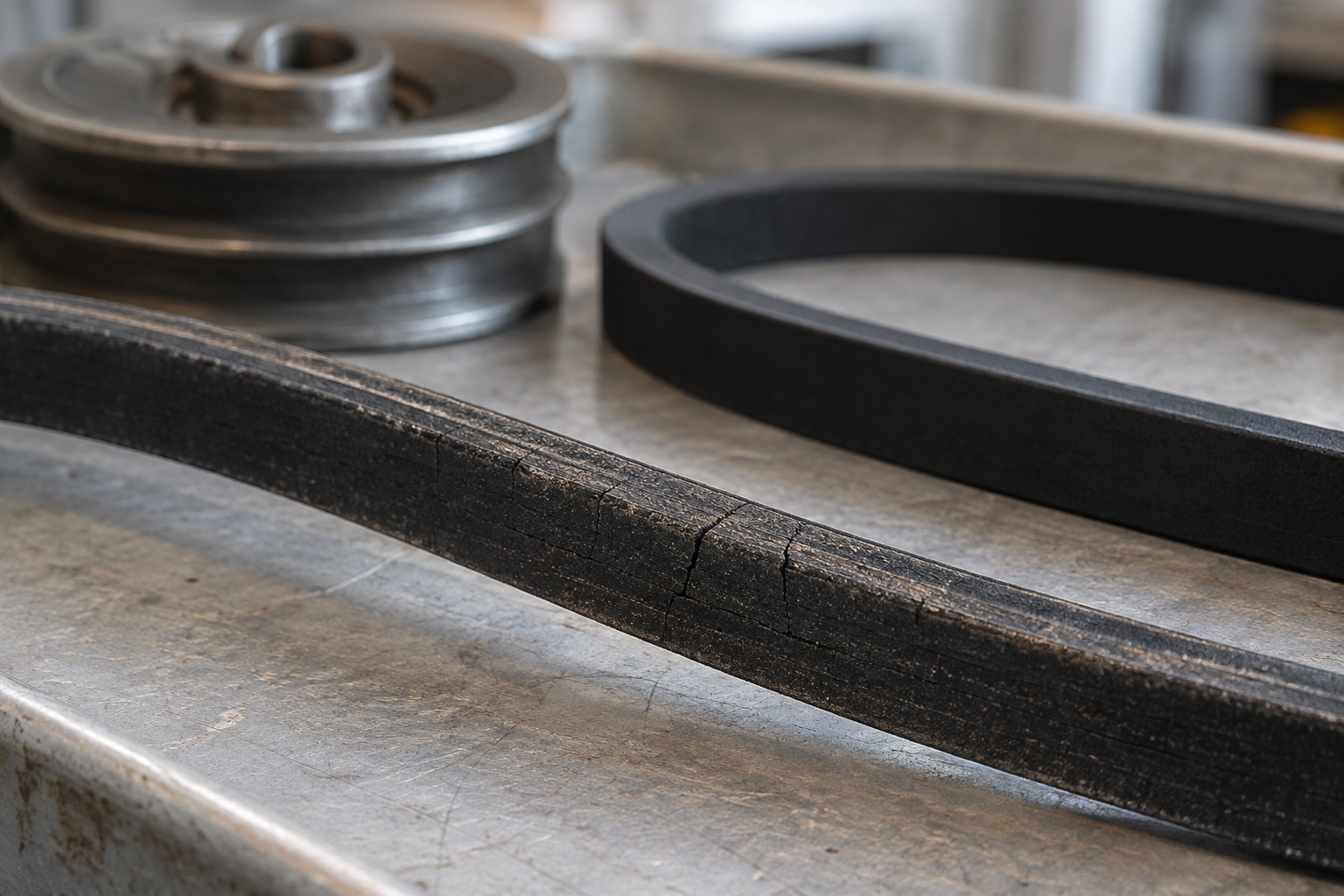
The short answerA damaged belt shows what happened to it, but not necessarily why. Use the wear pattern to choose the next inspection, then check the drive condition and operating history before replacing the belt or changing its construction.
Replacing a failed belt with the same reference can restore a machine quickly. It does not explain a short service interval. A useful investigation connects the failed part, the drive and the timing of the problem instead of assigning a cause from a single photograph.
Use symptoms to organise the investigation
Belt problems can originate in the drive geometry, installation, operating conditions or surrounding environment. The table below is a diagnostic starting framework: the same symptom can have more than one explanation.
| Observation | Questions it raises | Evidence to separate the possibilities |
|---|
| Uneven or one-sided wear | Is contact or alignment unequal? | Compare affected belt faces, pulley alignment and nearby contact marks. |
| Glazed sidewalls or heat damage | Was there slip, heat exposure or unsuitable contact? | Relate the pattern to load changes, pulley condition and operating history. |
| Cracking | Is bending, ageing, heat or handling involved? | Record crack location, service age, storage history and the drive geometry. |
| One belt deteriorates ahead of a set | Are the belts sharing the duty as intended? | Compare the complete set, its references and individual pulley-groove condition. |
| The problem starts just after maintenance | What changed during the intervention? | Review the replacement reference, set composition, installation and settings. |
Symptoms suggest inspection priorities; they are not remote diagnoses or instructions to adjust a running drive.
Reconstruct the change before the failure
Ask when the drive last operated normally and what changed afterwards. Distinguish a failure after years of service from one immediately after a pulley change or a new replacement reference. Those histories should not lead to the same first assumption.
A short timeline can contain the last normal interval, maintenance event, first unusual behaviour and final shutdown. Attach photographs to that timeline. This preserves context that is easily lost when the failed belt arrives at a purchasing desk on its own.
Worked example · illustrativeThree replacements in six weeks
Imagine a drive that previously ran for a long interval but required three belt replacements after a maintenance event. One response is to buy a more expensive belt. A more informative first investigation is to identify what changed at that event.
If the investigation finds a changed pulley, a mismatched belt reference or altered adjustment, the corrective action should address that finding. If none is found, the record still narrows the problem. The sequence does not prove a cause; it prevents the purchasing decision from becoming the diagnosis.
Inspect the drive as a system
The belt is one element of a system that includes pulleys, shafts, bearings, tensioning arrangements, guards and the driven load. A part substitution should therefore be evaluated against the cause being addressed. Greater advertised capacity is not evidence that the original problem has been removed.
Have trained personnel inspect an isolated drive under the site’s procedures. Use the selected manufacturer’s tension and installation method; a generic extra turn of the adjuster is not a controlled correction.
Define what a successful correction means
State the observation the action should improve and the conditions under which it will be checked. Retain the approved belt reference, findings and follow-up result with the machine record. That turns a one-off replacement into information the next maintenance and purchasing team can use.
The aim is not to diagnose every failed belt by its appearance. It is to turn the appearance into a better question, obtain evidence from the drive, and act on the finding.