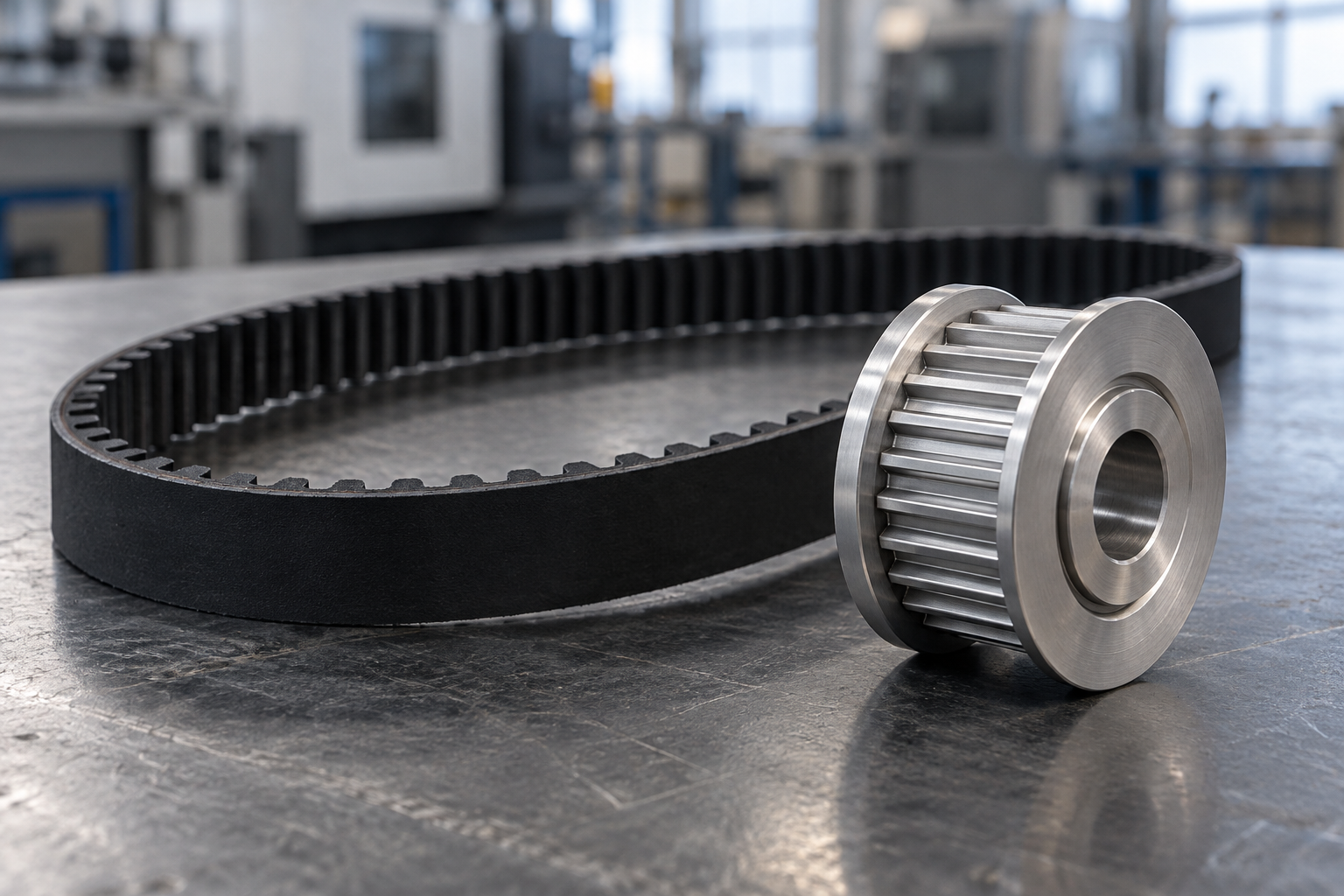
The short answerEqual pitch means equal spacing between teeth. It does not prove that the tooth shape fits the pulley. Compatibility also depends on the exact profile, tooth count, width, construction and the drive’s design requirements.
A replacement timing belt may have the expected width and appear to engage the pulley, yet still be the wrong design. Start by separating dimensions you can calculate from features that require an exact profile or product reference.
Pitch and tooth profile answer different questions
Pitch describes repeated spacing. Tooth profile describes the geometry of the engagement. Imperial and metric tooth-profile families can have different engagement geometries. Rubber and polyurethane belts can also differ in construction. These distinctions belong in the part definition, rather than being reduced to “a toothed belt”.
| Parameter | What it tells you | What it does not establish |
|---|
| Pitch | Spacing between successive teeth. | The complete tooth and pulley-groove shape. |
| Tooth count | How many pitches form an endless belt. | Belt width or load capacity. |
| Pitch length | Length at the defined pitch reference. | Outside circumference or construction. |
| Width | Nominal belt width. | Pulley compatibility or permissible transmitted load. |
| Construction | Body material, tension member and open/joined/truly-endless form. | An application rating without the product’s design data. |
Comparison framework. Product-specific limits remain those of the selected manufacturer.
Use the calculation that can be checked
For an endless synchronous belt, pitch length is the tooth count multiplied by pitch: Lp = z × p. Keep the units consistent. This arithmetic can detect a contradictory designation, but it is not a drive-capacity calculation.
Worked example · illustrativeCheck a 5 mm-pitch belt
An illustrative belt has 120 teeth and a 5 mm pitch. Its pitch length is 120 × 5 = 600 mm. A listing that simultaneously states 120 teeth, 5 mm pitch and 650 mm pitch length contains a discrepancy that needs resolution.
A 600 mm pitch length still leaves the exact profile, width and construction open. Two candidates that pass the arithmetic check may require different pulleys or have different application limits.
A consistency check · not a compatibility approval
ptooth pitch
ztooth count
Lp = z × ppitch length
The equation checks pitch length. It does not compare tooth shapes, materials or drive ratings.
Rubber or PU is another selection branch
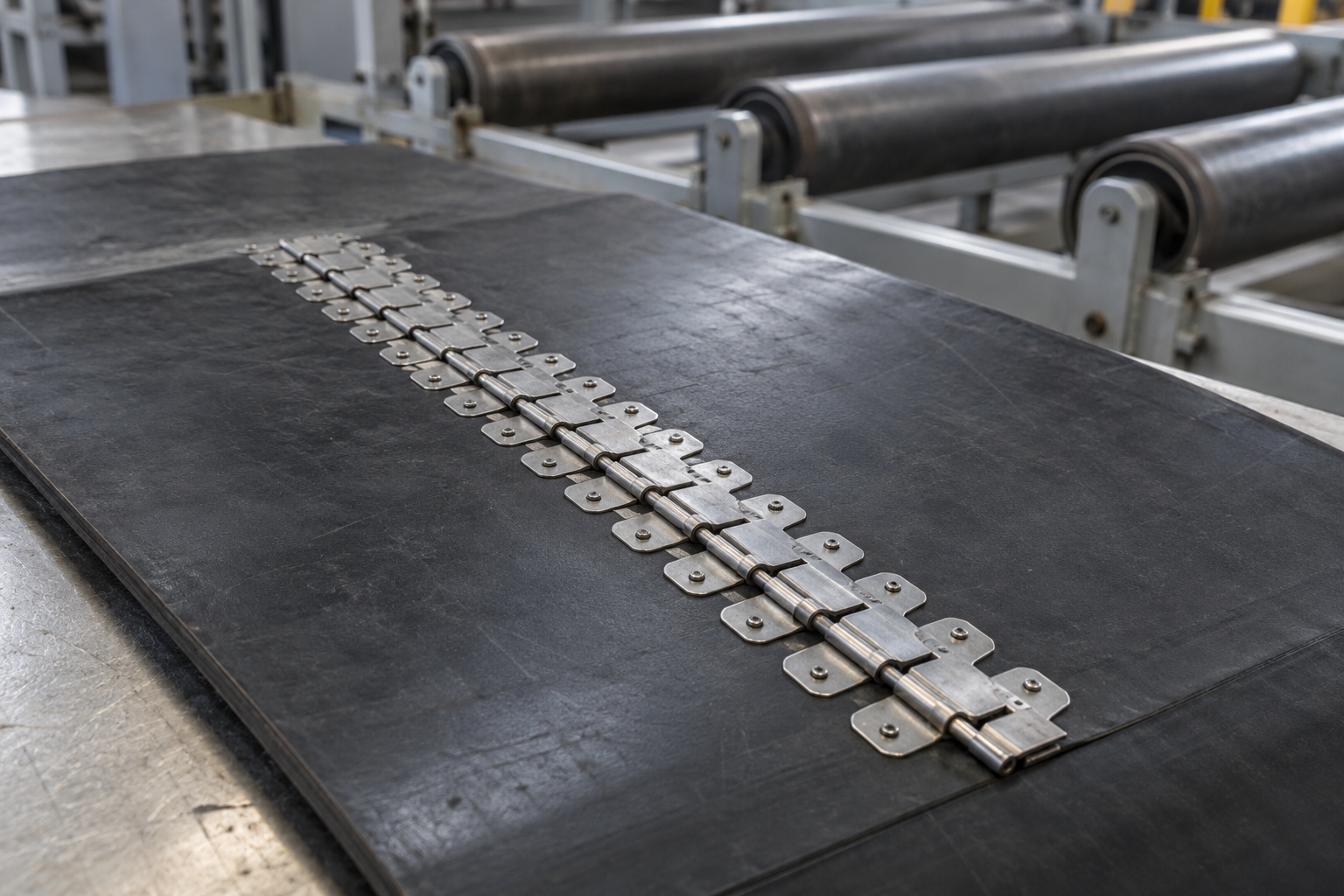
The body material is only one part of construction. Reinforcement and manufacturing form matter too. An open-ended belt used in a linear axis should not be described as though it were the same product as a truly endless power-transmission belt. A joined loop should retain its own construction identity.
For an OEM, the bill of materials should preserve these distinctions. A supplier offering an alternative needs to show which fields match and which change; a shared pitch value should not erase that comparison.
What a pulley review should resolve
Identify the pulley’s profile and drawing or complete part reference. Confirm the intended belt combination using the selected manufacturer’s information. A short hand-fit test does not reproduce the operating load, speed, alignment and tension conditions.
For indexing or positioning, include the required motion and accuracy in the application review. For power transmission, provide load and speed information. The same dimensional belt description may be used in applications that ask very different things of the drive.
A useful replacement record
Keep the exact profile, pitch, tooth count, width, construction and mating pulley reference together. That record allows a later buyer to distinguish a dimensional match from an approved replacement. It also prevents a calculation such as 120 × 5 from being mistaken for a complete engineering selection.