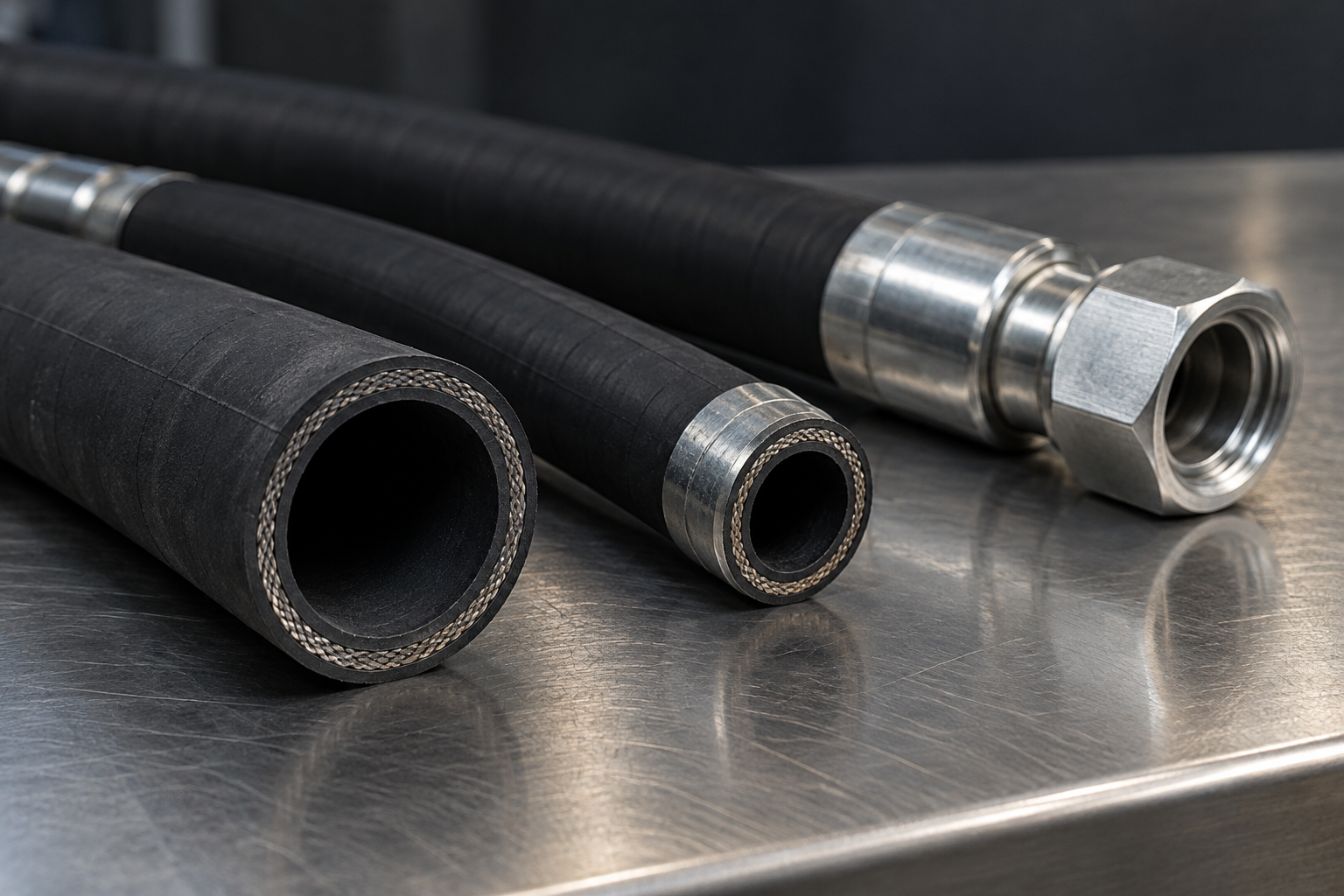
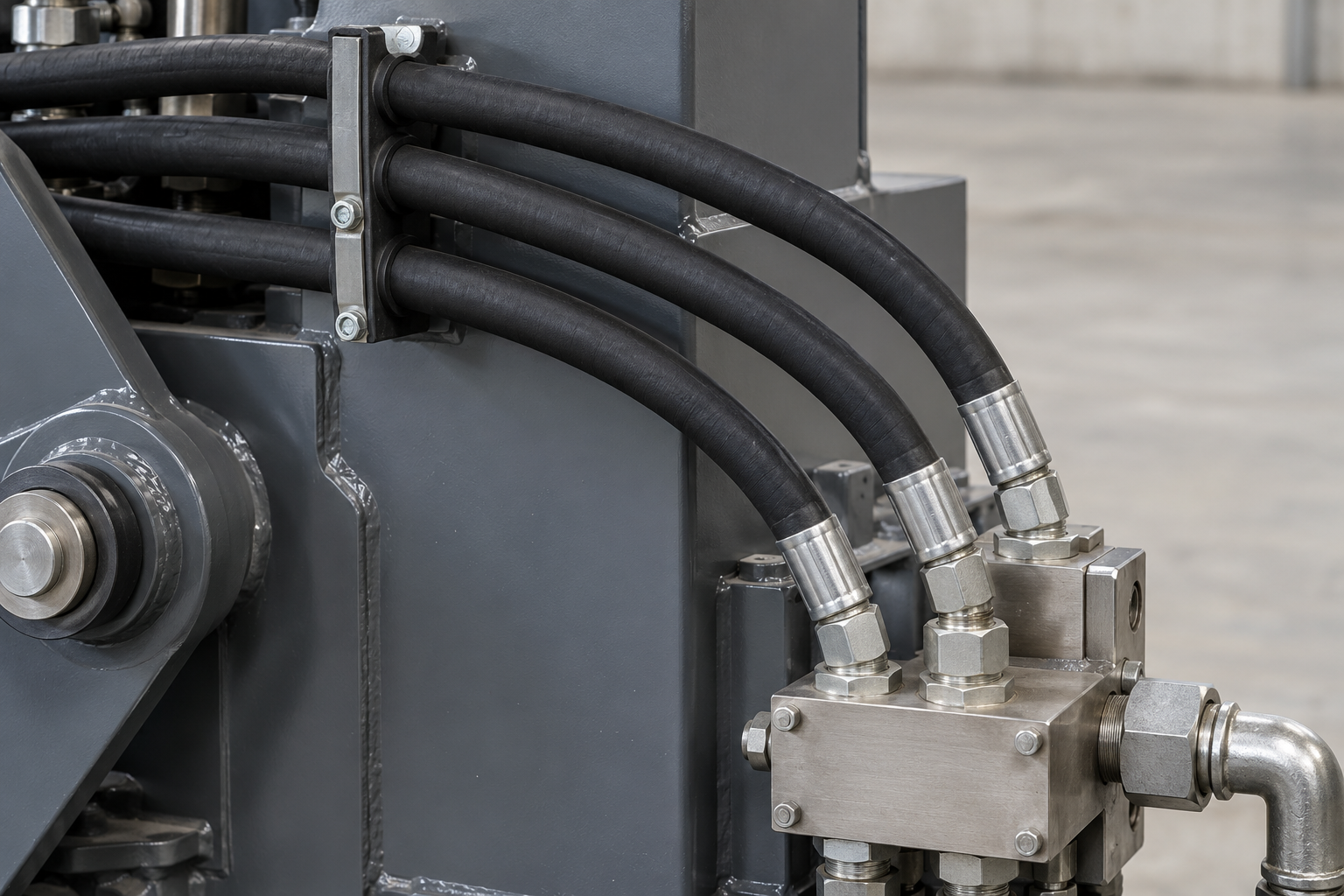
The short answerA hose dash number commonly expresses nominal bore in sixteenths of an inch. DN is a nominal designation, not a guarantee of an exact measured bore. Size selection also needs flow, pressure, fluid, temperature and routing—not the end connection alone.
A hose can connect to the right ports and still have the wrong bore for the circuit. The connection identifies an interface; the bore influences fluid velocity. Reading those as the same “size” hides a useful engineering distinction.
Translate a dash number carefully
The dash-size convention expresses nominal hose bore as a fraction of an inch. For the common inch-based convention, divide the dash number by 16 to obtain the nominal inch size. Always check the actual product’s dimensional table; nominal size is not an inspection tolerance.
| Dash size | Nominal inch bore | Exact conversion of that inch value |
|---|
| -4 | 4/16 = 1/4 in | 6.35 mm |
| -6 | 6/16 = 3/8 in | 9.525 mm |
| -8 | 8/16 = 1/2 in | 12.70 mm |
| -12 | 12/16 = 3/4 in | 19.05 mm |
These are arithmetic conversions of nominal inch sizes, not measured-bore requirements or a universal DN equivalence table.
A catalogue may use a rounded nominal metric designation alongside an inch size. Retain the supplier’s designation and its stated actual dimensions rather than forcing every value into an exact conversion. For an adapter, identify the connection at each end separately from the hose bore.
Calculate velocity from actual bore
Average velocity follows v = Q/A, with cross-sectional area A = πd²/4. When Q is in litres per minute and internal diameter d is in millimetres, this becomes v ≈ 21.22 × Q/d² in metres per second.
The squared diameter is the important relationship: at the same flow, doubling bore diameter reduces average velocity to one quarter. That is a geometric result, not a product performance guarantee.
Worked example · illustrativeThe same flow through two bores
For an illustrative flow of 30 L/min, a 10 mm actual bore gives approximately 21.22 × 30 / 100 = 6.37 m/s. A 16 mm actual bore gives approximately 21.22 × 30 / 256 = 2.49 m/s.
These are calculated velocities, not recommended operating limits or approved hose selections. The example explains why an apparently modest diameter change matters. Selection must then use the circuit’s requirements and the selected manufacturer’s guidance.
Velocity is not pressure drop
The velocity calculation does not give the pressure lost along a hose assembly. Length, actual bore, fluid properties and temperature, fittings and the flow regime also influence the pressure-drop review. A hose can pass the pressure rating check while still imposing an unacceptable loss on a particular circuit.
Compare candidate sizes at the same flow and conditions. If one offer quotes only nominal diameter, use its actual dimensional data before treating the calculated velocity as a comparable result.
Keep pressure and hose construction in view
Increasing size does not automatically preserve the working-pressure rating. Review the exact size within the proposed hose range. Also check whether the complete hose-and-fitting assembly is validated for the intended pressure, fluid and temperature. A size calculation cannot authorise an unvalidated assembly combination.
The concise sizing sequence is therefore: establish duty and fluid, calculate the bore/flow relationship, review pressure loss and product limits, then check the physical route and assembly compatibility. Each step answers a different question.